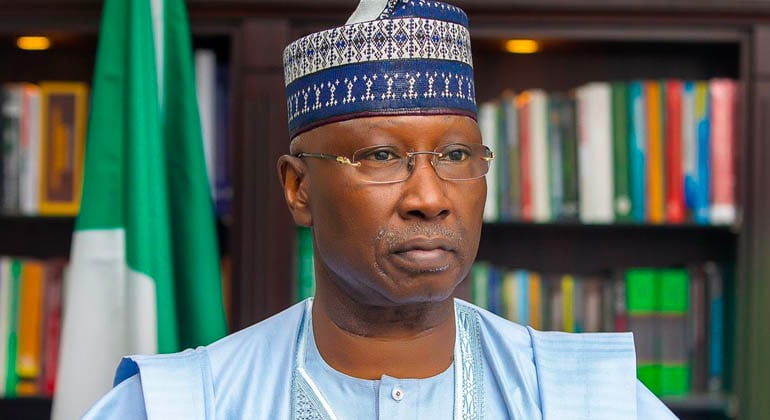
Former Secretary to the Government of the Federation, Boss Mustapha, has urged the Federal Government to adopt robust diplomatic engagement in responding to the decision of United States President, Donald Trump, who, in an X post named Nigeria a “country of particular concern.”
Recall that Trump in October declared Nigeria a ‘country of particular concern’ in response to allegations of a Christian genocide in the country.
Speaking in Abuja on Thursday at a briefing to announce activities marking the 45th Anniversary Reunion Gala and Lecture of the Nigerian Law School Class of 1980, Mustapha, said this is not the first time Nigeria will be declared a Country of concern.
He recalled how the Buhari administration resolved similar classifications through quiet, strategic diplomacy.
He said Nigeria’s previous appearance on the same US list in 2020, during the tenure of the late former President Muhammadu Buhari, was resolved after the government successfully lobbied for the country’s removal through soft diplomacy.
“Because of the experience I have, this is not the first time we’ve been declared a country of particular concern. In 2000 and 2020, the same Trump put us there, but without the drama that this one followed. There was no tweet. It was just at the level of a policy decision, and I remember we then engaged and dispatched a team to Washington, made up of technocrats.
“We applied soft diplomacy in terms of reaching out to friends within the global diplomatic community, and we leveraged the advantage of the stature of President Buhari to talk, and eventually we got Biden in 2021 to delist us.”
He advised the current administration to prioritise discreet, sustained diplomatic engagement rather than public rhetoric, noting Buhari’s frequent reminder that dealing with superpowers requires caution.
“I expect that is what is ongoing now, and I believe that there should be less noise and more engagement. President Buhari will always remind me that America has a big stick, and if they hit your head with it, the headache will never disappear. In his lighter moods, he would always remind me that caution in dealing with superpowers is important. Constant engagement, political back-end engagements, and leveraging friendship globally are equally important in the resolution of the issues now”.
He expressed optimism that Nigeria will resolve it, emphasising that Nigeria’s size and strategic importance make instability in the country a threat to the entire African continent.
“Nigeria is a great country. We have 230 million people. If anything happens to Nigeria, the consequences will overwhelm West Africa and beyond. The world cannot afford the fallout of 230 million people in crisis.
“If anything happens to this country, if we explode and just walk across West Africa, we’ll eat up all the food, and there will be starvation. People will die of starvation by our share number. So even globally, the world is not interested in the breakup of Nigeria.
“I can tell you that because they know the enormity of the problems that will overflow Africa. Not West Africa, Africa. Right now, our people have travelled to different areas and different countries. Even the migration issue has become a matter of concern for those nations”, he said.
Speaking on national security challenges, the former SGF lamented the erosion of Nigeria’s communal and family values as well as the rate of increasing intolerance across the country.
He called for a societal shift back to shared values, urging Nigerians to be their brother’s keeper.
He stressed that every nation must discover homegrown solutions to its problems.
“There are global crises all over the world, and we are partakers; we are getting our share of it. There must be a new renaissance of the Nigerian people to go back to our ike ways. Our communal values, our family values, have totally been eroded. The government has its limitations. The people must take responsibility to restore what we used to be, our humanity, our care for one another, our sense of community.”
He added that evolving indigenous responses to insecurity, economic hardship, and climate-related pressures was critical to rebuilding national cohesion.
“We must be our brother’s keepers, we must care for human life. If we do not return to those old days, and old ways, we will continue to drift. As I said, it’s a global phenomenon”.
Mustapha urged Nigerians to recommit to unity despite diversity: “We must decide who we are and whether we can live together in our differences to lift this nation from where it is today.”
Speaking on the community impact of the NLS 1980 class, Mustapha said a correctional outreach was done which resulted in the support and release of eight inmates in the Nigerian Correctional Facility Keffi.
The reunion, scheduled for November 27–30, in Abuja, is themed “The Nigerian Legal Profession at Crossroads”. It will feature a keynote lecture titled “Reassessing the Nigerian Legal Profession in the 21st Century – A Cry for Urgent Reforms”, to be delivered by Prof Andrew Chukwuemerie (SAN), with contributions from Emmanuel Ukala (SAN) and Prof Koyinsola Ajayi (SAN).