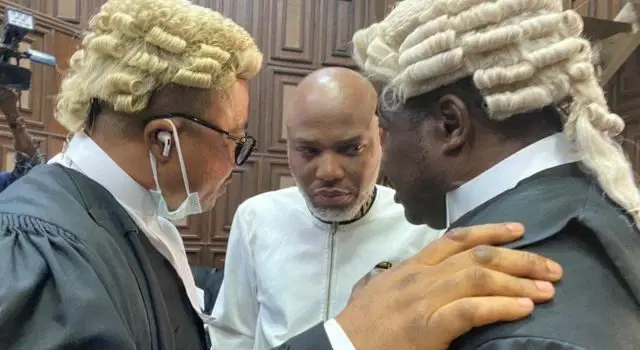
The Federal High Court in Abuja on Thursday, adjourned till Friday, October 24, for the detained leader of the Indigenous People of Biafra, Nnamdi Kanu, to enter his defence in his ongoing trial.
Trial judge, Justice James Omotosho, fixed the date after Kanu’s lead counsel, Former Attorney General of the Federation, Kanu Agabi (SAN), informed the Court that they will be stepping down from the trial as wanted by the defendant.
Kanu is standing trial on a seven-count charge brought against him by the Federal Government.
The IPOB leader was first arrested in October 2015 and charged with treasonable felony.
He was later granted bail in April 2017 but fled the country following a military operation in Abia State. He was re-arrested in Kenya in June 2021 and extradited to Nigeria to face an amended terrorism-related charge.
The Federal Government filed a 15-count charge against him when he was re-arraigned before the Federal High Court in Abuja in January 2022.
However, on April 8, 2022, Justice Binta Nyako of the Federal High Court struck out eight of the 15 counts, leaving seven counts for Kanu to face.
The court struck out the eight counts on the ground that they were repetitive, vague, or did not disclose any offence under the Terrorism Prevention Act or other applicable laws.
Subsequently, in October 2022, the Court of Appeal in Abuja went further to quash all seven remaining charges and discharged Kanu, holding that his extraordinary rendition from Kenya to Nigeria was unlawful and deprived the trial court of jurisdiction.
However, in December 2023, the Supreme Court overturned the Court of Appeal’s judgment, ruling that while the rendition was illegal, it did not nullify the charges.
The case was therefore remitted to the Federal High Court to continue trial on the 7 surviving counts.
The amended seven-count charge, filed by the Federal Government through the Office of the Attorney-General of the Federation, borders primarily on terrorism, incitement, and promotion of unlawful activities under the Terrorism (Prevention and Prohibition) Act, 2022 and other related laws.
The seven counts currently before the Court marked FHC/ABJ/CR/383/2015, against Kanu States, that he perpetuated Acts of Terrorism through Radio Broadcasts.
It argues that Nnamdi Kanu, between 2018 and 2021, in London, United Kingdom, made broadcasts on Radio Biafra, which were transmitted into Nigeria, inciting violence and acts of terrorism against the Federal Republic of Nigeria, contrary to Section 1(2)(b) of the Terrorism Prevention and Prohibition Act, 2022.
Count two States that Kanu knowingly incited members of IPOB to attack security agents, destroy public facilities, and disrupt governance in the South-East region, thereby committing an offence under Section 6 of the same Act.
Count three contends that Kanu directed and financed the activities of IPOB, an organisation proscribed and declared a terrorist group by a Federal High Court order in 2017, in violation of Section 2(3)(a) of the Terrorism Prevention and Prohibition Act, 2022.
Count four states that he made broadcasts containing false statements and inflammatory rhetoric intended to cause fear and disaffection among Nigerians, thereby committing an offence under Section 15 of the Cybercrimes (Prohibition, Prevention, etc.) Act, 2015.
Count five accuses him of making Calls for Secession of the South-East Region through Radio Biafra broadcasts, stressing that Kanu called for the separation of the South-East and other parts of Nigeria to form the Republic of Biafra, thereby committing an offence under Section 41(c) of the Criminal Code Act, Cap C38, Laws of the Federation of Nigeria, 2004.
Count six states that Kanu managed and directed an unlawful organisation, the Indigenous People of Biafra, contrary to Section 63 of the Criminal Code Act, punishable under the same section.
Count seven States that he knowingly imported and possessed a radio transmitter — a Tram 50L model — concealed in a container and declared as a household item, without lawful authorisation, contrary to Section 47(2)(a) of the Criminal Code Act.
Kanu, in a fresh motion where he personally signed his defence notice, marked FHC/ABJ/CR/383/2015, dated October 20 and filed the following day, named several top political figures and retired military chiefs — including the Minister of the Federal Capital Territory, Nyesom Wike; Lagos State Governor, Babajide Sanwo-Olu; and former Chief of Army Staff, Lt. Gen. Tukur Buratai (retd.) — as witnesses in his ongoing terrorism trial.
Kanu, in the motion, told the court of his intention to call 23 witnesses divided into two categories — “ordinary but material witnesses” and “vital and compellable witnesses.”
Among the latter category are prominent individuals such as former Minister of Defence, Gen. Theophilus Danjuma (retd.); former Chief of Army Staff, Gen. Tukur Buratai (retd.); and the Governors of Lagos and Imo States, Babajide Sanwo-Olu and Hope Uzodinma.
Others listed include the Minister of Works, David Umahi; Minister of the Federal Capital Territory, Nyesom Wike; former Abia State Governor, Okezie Ikpeazu; and the immediate past Attorney-General of the Federation, Abubakar Malami (SAN).
Also named are the Director-General of the Department of State Services, Yusuf Magaji Bichi; the immediate past Director-General of the National Intelligence Agency, Ahmed Abubakar; and several other unnamed individuals.
According to the motion, Kanu intends to rely on Section 232 of the Evidence Act, 2011, to compel the appearance of those he considers “vital and compellable” witnesses.
He also asked the court to grant a 90-day window to enable him to conclude his defence, pledging to testify personally and provide sworn statements from voluntary witnesses to support his case.
“I will testify on my own behalf, providing a sworn account of the facts, denying the allegations, and explaining the political context of my statements and actions,” Kanu told the court.
“It will interest the honourable court and the general public that justice is not only done but is manifestly seen to have been done.”
Meanwhile, at the last sitting, the Court had fixed Thursday for the IPOB leader to open his defence.
When the matter was called upon at the resumed sitting, Agabi informed the court that he would no longer be representing the IPOB leader, adding that the defendant had taken the case from them.
Agabi stated, “We are withdrawing because the defendant has taken this case back from us and we respect that.”
All of the Senior Advocates representing the IPOB leader withdrew from the matter as well.
Onyechi Ikpeazu (SAN), Paul Erokoro (SAN), Emeka Etiaba (SAN,) among others, are members of the legal team who withdrew from the case.
Kanu, on his part, confirmed the submission of the counsel attesting to the development, noting that he would be representing himself for now.
He, however, added that that may change later.
He told the court that he was willing and ready to conduct his case by himself.
Justice Omotosho, however, asked him if he should be given a lawyer. Kanu responded in the negative.
The judge afterward ordered other members of the defendant’s legal team who were in court, except the Senior Advocates, to vacate the courtroom immediately and then asked Kanu to open his defence.
Meanwhile, defending himself orally, Kanu said the court lacks the Jurisdiction to try him.
Omotosho, however, disagreed with him, insisting that he must proceed with his defence.
Ikpeazu prayed the Court to allow him a little more time to prepare, drawing the attention of the court to the fact that their (Kanu’s lawyers’) withdrawal took effect Thursday morning.
Since the prosecuting counsel did not object, Justice Omotosho adjourned till Friday, October 24, for Kanu to open his defence.